Research Verticals
Areas of Investigation
Our research programme addresses fundamental questions in fluid mechanics, structural dynamics, and biological systems through advanced computational and experimental methods.
Ocular Biomechanics
Investigating the fluid-structure interaction between the cornea and rapid air puff during non-contact tonometry. Our work uses Arbitrary Lagrangian-Eulerian (ALE) deforming mesh methods and finite element modelling to characterise corneal material properties, understand intraocular pressure effects, and develop patient-specific models using machine learning.
Key Research Areas

Rheology & Soft Matter
Characterising the complex rheological behaviour of non-Newtonian fluids, including self-assembling functionalised dipeptide surfactant solutions, yield stress fluids, and viscoelastic materials. Our research explores second normal-stress differences, LAOS analysis of protein-pectin networks, and the architecture-dependent gelation of dipeptide hydrogels.
Key Research Areas

Multiphysics & CFD
Employing high-fidelity computational methods including Direct Numerical Simulation (DNS) to study turbulent pulsatile flows relevant to understanding blood flow dynamics in large arteries. Our data-driven approaches combine advanced simulation with machine learning to develop reduced order models for complex multiphysics problems.
Key Research Areas
Microfluidics
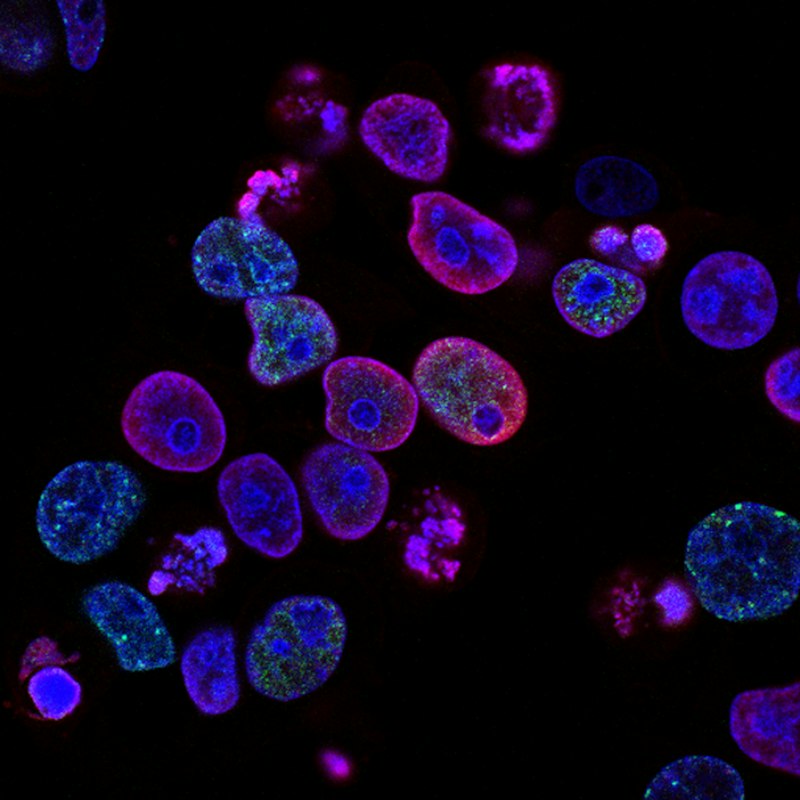
Investigating droplet generation and multiphase flows at the microscale using our Elveflow Easy Droplet Generation kit. Our microfluidics research explores the physics of confined flows, droplet dynamics, and interfacial phenomena, with applications in lab-on-a-chip systems, emulsification, and controlled encapsulation.
Key Research Areas

Thermal Management of Electronic Devices
Addressing the growing thermal challenges of modern data centres, HPC clusters, and AI accelerators such as the NVIDIA B200 and H100. Our work combines high-fidelity computational modelling with experimental characterisation to develop next-generation liquid cooling solutions — including direct liquid cooling, vapour chambers, and cold-plate heat sinks — that maximise thermal efficiency and energy performance.
Key Research Areas
Impact & Case Studies
Research in Action
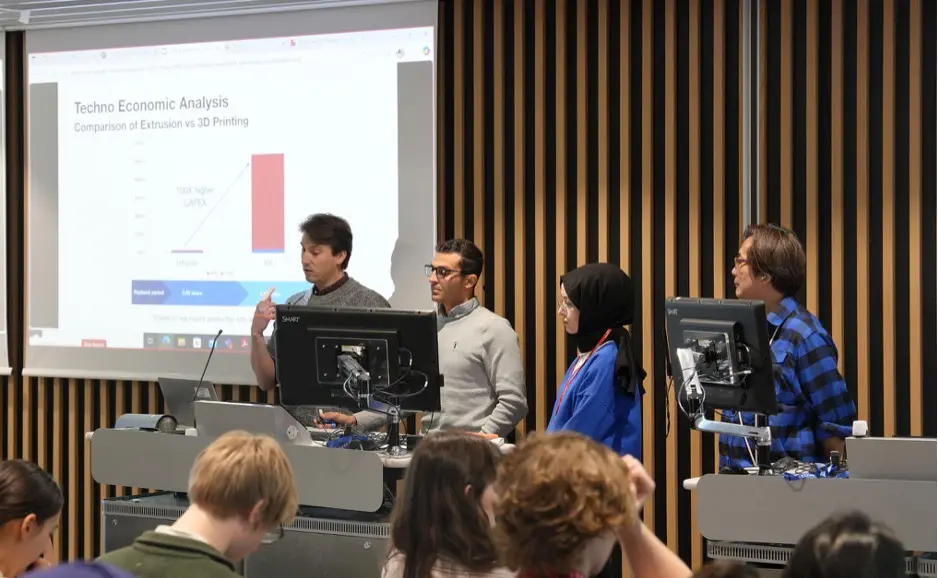
Beyond 3D Printing: Reimagining Steak with Extrusion
Challenge Provider: Space Steak (Hiromichi Ito) · Team: Jordan Pennells, Osama Maklad, Sena Cakir · Prize: Free IP consultation from Potter Clarkson
The team combined AI-driven image analysis, computational flow modelling, and techno-economic assessment to design a scalable, data-informed method for generating realistic marbling through extrusion. Key innovation: an AI Marbling Grader Dashboard quantifying a composite Marbling Index (MI) based on fat coverage, orientation dispersion, and lacunarity — enabling real-time optimisation of texture and structure.
Techno-economic analysis revealed extrusion's clear industrial advantage: at equivalent output, extrusion offered an estimated payback period of 0.03 years vs. 2.12 years for 3D printing.
Industry Context
Liquid Cooling for AI & HPC
As AI workloads and HPC demands surge, thermal management has become a critical engineering challenge. The following examples illustrate state-of-the-art liquid cooling technologies that motivate and contextualise our modelling and experimental research.

NVIDIA B200 System Liquid Cooling Solution
The NVIDIA B200 Tensor Core GPU is the latest powerhouse in AI and HPC, delivering unprecedented performance for data centres. Liquid cooling solutions are essential to maximise thermal efficiency and sustain peak compute density.

Intel LGA 4189 Water Cooled Server CPU Heat Sink
Traditional air cooling is increasingly insufficient for modern server CPUs. Water-cooled heat sinks for Intel LGA 4189 platforms represent the shift toward direct liquid cooling in high-density data centre environments.

Copper Vapour Chamber Heat Sink
Vapour chambers offer near-isothermal heat spreading for high-flux electronics. Copper VC heat sinks are increasingly adopted in AI accelerator boards where traditional heat pipes reach their thermal limits.

Liquid Cooling Solution for NVIDIA H100
Purpose-built liquid cooling for the NVIDIA H100 enables sustained teraflop-scale inference and training throughput in data centres — a key driver for our research into conjugate heat transfer and thermal optimisation.
Recognition & Awards
Research Impact
Best Paper Award
13th International Conference of Fluid Dynamics (ICFD13), 2018
PhD Scholarship
University of Liverpool, 2015–2019
Reviewer
Soft Matter, Acta Biomaterialia, Applied Sciences, Nanoscale
CAMM Member
Centre for Advanced Manufacturing and Materials
CASM Member
Centre for Advanced Simulation and Modelling
C-SMART Member
Centre for Synthesis, Materials, Analytics, and Research in Translational Science
EPSRC NFFDy
Summer Programme 2024, University of Leeds
MFIC Member
Medway Food Innovation Centre, University of Greenwich

